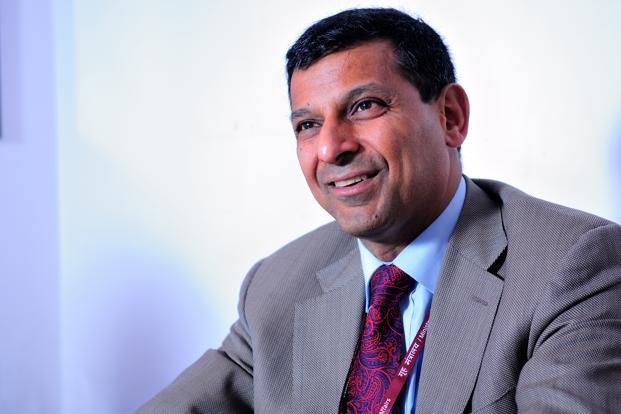
In early March, addressing the Fixed Income Money Market and Derivatives Association of India-Primary Dealers Association of India annual conference, Reserve Bank of India (RBI) governor Raghuram Rajan said the central bank’s policy rate was appropriately set. Instead of administering shock therapy to a weak economy, RBI would prefer to disinflate over time, while being prepared to do all that was necessary if the economy deviated from the projected inflation path, he said.
If one reads this in conjunction with the last policy statement which said, “The extent and direction of further policy steps will be data dependent, though if the disinflationary process evolves according to this baseline projection, further policy tightening in the near term is not anticipated at this juncture”, one can presume that Rajan will opt for status quo when he announces the monetary policy on 1 April.
Since September, he has raised the policy rate thrice, by a combined 75 basis points to 8%, to manage inflationary expectations in Asia’s third largest economy. One basis point is a hundredth of a percentage point.
The February wholesale price inflation figure dropped to 4.68% from 5.05% in January, a nine-month low and much below the consensus estimate of 4.9%. Driven by vegetable prices, the February consumer price inflation (CPI) too at 8.1% was below the consensus estimate of 8.3% and about 70 basis points less than its January figure. The February CPI was also the lowest since January 2012 when it was 7.65%.
Incidentally, the divergence between consumer price inflation and wholesale inflation declined to a four-month low in February and both the figures have been on a decline since November. Consumer price inflation has contracted by 306 basis points since November while the shrinkage in wholesale price inflation is 284 basis points.
This should not give one the impression that RBI may go for a rate cut in the April policy as inflation figures have probably bottomed out, and from now on both headline inflation as well as the so-called core inflation, or non-food, non-oil, manufacturing inflation, will inch up. Food prices will come under pressure due to unseasonal rains and hailstorms across some of the major farming states and the probability of El Nino this year. The recent increase in dearness allowance of government employees will also add to the inflationary pressure. Of course, relatively softer global commodity prices and a stronger rupee could, to some extent, offset the pressure but this is unlikely to encourage Rajan to change his policy stance.
The guiding principle is clearly the Urjit Patel committee report on monetary policy that has charted out a road map for consumer inflation—8% by January 2015, 6% by January 2016 and 4% with a two percentage point band thereafter—even though it has not yet been officially accepted by the central bank. In January, Rajan surprised the market by hiking the policy rate despite a decline in inflation figures after choosing to keep key policy rates unchanged in December even though both retail and wholesale inflation accelerated. Rajan had said he would wait for more data to take a call on the policy rate trajectory.
The January policy guidance had not spoken about a rate cut, but in his interaction with the media after the announcement of the policy, Rajan hinted at following “an accommodative monetary policy” if inflation drops. Indeed, both wholesale and retail inflation have dropped but it is highly unlikely that he would opt for a rate cut or even sound dovish in articulating the policy. This is because the battle against inflation is far from over and core inflation continues to remain high.
January’s industrial production data was better than expected (0.1% after three months of contraction), but growth remains tepid and the investment cycle is yet to take off. This may encourage RBI not to go for a hike and keep the rates on hold in April, but one can’t be sure that the rate tightening cycle is over. I will not be surprised if Rajan sounds hawkish in his policy while highlighting the upside risks to inflation. If he indeed wants to contain retail inflation at 8% in January 2015 and 6% in January 2016, as has been recommended by the Patel committee, he cannot afford to let his guard down against inflation.
Whether the Patel committee recommendation on inflation targeting will be accepted or not will depend on the new government that assumes power after the April-May general elections, but at this point it seems the finance ministry and RBI have reached an understanding on the efficacy of inflation targeting. After addressing the central board of RBI in the first week of March, finance minister P. Chidambaram had said that the government, through Parliament, should be setting the inflation number for the central bank to target. Earlier, he had expressed strong reservations about the report and said the central bank must keep the objectives of supporting growth and “inflation-targeting is only one among the objectives”.
Chidambaram’s latest statement is in sync with what Rajan had told an Australian TV channel in February—that Parliament should be setting the inflation target. On the sidelines of the G20 summit in Sydney early March, Rajan had said the government and RBI were on the same page in terms of inflation-targeting. He had also said the 6% retail inflation target by January 2016 would be met without extreme hardship.
If indeed he has fixed this goal, one would expect the Indian central bank to tighten the monetary policy in the later half of the year with inflation inching up, while holding on the current level of policy rate in April.