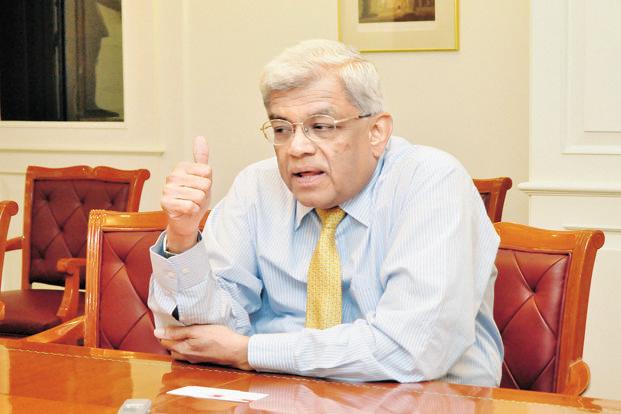
Deepak Parekh,chairman of Housing Development Finance Corp. Ltd, India’s largest mortgage lender, and the unofficial crisis consultant for the government by being a member of almost all its key committees, is convinced that the worst is over for the Indian economy as reforms are back on the track.
In an interview on Friday at HDFC’s headquarters, Parekh spoke on issues ranging from the change in investment climate to the government’s resolve to stick to the fiscal deficit target, the likely impact of the land reforms law, divestment of the government’s stake in state-owned enterprises, the current account deficit, the future of the rupee, interest rates and the fall in real estate prices. Edited excerpts:
The government seems to be aggressive in pushing for reforms. Are things looking better?
It is a unanimous view that the worst is over and things are looking better. Reforms are back on track. The Prime Minister has made a fervent appeal to the opposition for support and cooperation on all Bills. This will help the Indian economy, and whoever comes to power in the next government will definitely take them forward.
What is your take on the food security law?
The FIIs (foreign institutional investors) are afraid that it will cost Rs.1.3 trillion. We have to appreciate that the states don’t yet have the infrastructure. The list of penetration and coverage is not in place… The warehousing facility is inadequate…It will take time to set up all these. Someone is talking about direct transfer of payment but how are they going to pay? Whom are they going to pay?
It will take at least a year to get this organized. Even today the government is spending Rs.80,000-Rs.90,000 crore on food subsidy. So, it is not a significant increase. And, it is not going to cost the government this year. I am aware of the fact that people are feeling that with the food security Bill and the rupee going down, crude price increasing and price of diesel going up, the government will not be able to contain fiscal deficit at 4.8% of GDP (gross domestic product).
What do you feel?
I am pretty clear that the red line will not be breached because these costs are all not going to come in this financial year. The fiscal deficit is the no. 1 objective of the Prime Minister and the finance minister. They have made a commitment and they will stick to it. It is not going to balloon because the food security Bill has been passed.
On the revenue side, we have an ambitious target—18% growth in direct tax collection and 20% growth in indirect tax collection. The growth in collection of income tax, which is bulk of the direct tax, was 14-15% in the first quarter. I am reasonably convinced that we will meet the target of income tax collection.
The problem is indirect tax. We had a 2% growth in the first quarter. But the revenue department and the government are chasing companies for service tax very hard. There are large numbers of companies who have not paid service tax. The finance ministry officials are reasonably confident that they will come close to the target. The customs and excise collection in the first five months have been subdued. But I don’t think that there will be a disaster and that we will achieve only 2% against a projected 20% growth.
A way to contain the fiscal deficit is to sell the government’s stake in public-sector undertakings (PSUs).
The PSU stocks are out of favour with FIIs, particularly the bank stocks. All bank stocks have been downgraded; their risks have become higher. Many banks today are available at below their book value. So at some stage, the FIIs will have to look at it. How can a bank be below its net asset value? Some companies are trading even below their cash value— the cash in them is more than their market capitalization.
The government has to look at divesting from companies where it has large holdings like Larsen and Toubro (Ltd), Hindustan Zinc (Ltd), Balco (Bharat Aluminium Co. Ltd), and ITC (Ltd), the Sutti (Special Undertaking of UTI) stocks. They are worth about $8 billion.
While doing that, the government must ensure that the existing management is not destabilized. For instance, in ITC, there is fear that BAT (British American Tobacco) will take over and the Indian management will get marginalized…We will have to ensure that doesn’t happen. So, the share sale should be done by auctions. The highest bidder should get the stake and we can put a cap of 2% to such sales—none can buy more than 2%.
You seem to be confident that the share sale will go through.
The first one will be Hindustan Zinc, then L&T and Axis Bank. I don’t think the government has a choice… It needs Rs.54,000 crore from share sale—Rs.40, 000 from divestment of its stake in PSUs and Rs.14,000 crore selling shares of companies the government does not control. It could also be IDFC (Infrastructure Development Finance Co. Ltd). There are many options.
You are confident on the government sticking to its fiscal deficit target. What about the current account deficit?
The government is trying various ways to bridge the gap. One of them is raising FCNR-B (foreign currency non-resident-bank) deposits. Borrowing overseas, FII debt, equity and external commercial borrowing (ECB) are some of the ways through which we can contain the current account deficit.
The government has permitted six companies to raise $8 billion. IIFCL (India Infrastructure Finance Co. Ltd) is going to access the market for a dollar billion and half loan. The three oil companies will raise another $4 billion. With their strong balance sheets and backing of the government, there will be no difficulty.
Then, money will come through the foreign direct investment (FDI) route. The Mylan (Inc.) deal will get us $1.6 billion (Mylan is buying a unit of Strides Arcolab) and Jet will get more than half a billion dollars (Ethiad Airways is buying 24% stake in Jet Airways (India) Ltd). The government has liberalized FDI norms and we will get more money. Unfortunately, five months of the fiscal year are over and we are left with only seven more months.
The FCNR-B deposit is a leveraged product for an NRI (non-resident Indian). They will not send money for their love of India; it is business decision. They will borrow from a local bank and send money to get a better return. The banks in the Middle East have negligible exposure on India. Similarly, the South East Asian Banks too have very limited exposure. The country limits are much higher. So, where is the risk? I expect money to come that way through this route.
Then, a parent company can give loans to subsidiaries in India. For instance, if a multinational company in India wants money, why would it borrow in rupees at a relatively high interest while the parent is sitting on cash which is earning very little?
There are large numbers of non-banking financial companies owned by foreign PEs (private equity funds). In order to blend the cost, the PEs may be willing to arrange debt for their subsidiaries in India and money can come through this route too. Even the manufacturing companies have finance arms.
Your take on the rupee?
I think the worst is definitely over. We have to prove to the world that we are sticking to the current account deficit and maintaining the 4.8% target of fiscal deficit. The reforms are going on, and it takes time for money to come in under various schemes. I don’t think that the rupee will be in a free fall any more but at the same time it will not go to 55.
You don’t expect FIIs to sell Indian stocks?
No, I don’t expect large outflow from the existing equity investors. We have seen an outflow of $6 billion in debt but on the equity side we are still positive of $11.6 billion.
Today, for most Indian stocks the valuations are so attractive.. Many stocks are trading at below their book value…We have a big market and there is some certainty that the rupee will not be on a free fall with the measures that the new RBI governor has taken. RBI will intervene in the market when necessary.
All these make me feel reasonably confident. I would have been more confident had there been one year left to achieve the targets but just seven months are left. The time is short.
But interest rates will not come down because inflation is there.
In a high interest rate scenario, how do you see consumer sentiment being affected?
It is not a high interest rate scenario. It is still moderate. We had seen much higher rates—15-16%.
The interest rate will remain elevated. The RBI governor is willing to increase liquidity in the system and look at a cut in SLR (statutory liquidity ratio or the banks’ mandatory bond holding) and CRR (cash reserve ratio or the portion of deposits kept with RBI) but you cannot expect interest rates to come down rapidly.
Won’t it affect consumer demand?
I expect rural income and rural demand to go up significantly. Agricultural production will grow 4%, which will also increase our GDP.
One also has to understand that India is a high savings rate country. In 2000, savings to GDP ratio was 24%, including household savings, and in 2010, it rose to 34%. Today it is 30-31%. As a nation, we are saving less and spending more. I don’t think consumer demand is going to just collapse. Yes, auto sales have slowed down for eight months in a row but tractor sales have been rising. That’s a very good sign.
What about the investment scenario?
The investments that had been approved and committed have been stalled. Those are the ones that are being cleared now by the project monitoring group and the cabinet committee on investment. The government has allowed many companies to go abroad and import coal. These companies are now running around to import coal.
The coal has to come to different ports and get transported. There will be a boom in shipping and port activities. Since the fuel supply cost is pass-through, nobody would keep their plants idle today. It will take time but many large projects which were on the back burner are now moving.
Coming to real estate, are you seeing a bubble there?
I don’t see a bubble. All real estate prices have come down significantly—commercial, office space, SEZ (special economic zone), IT space, retail and shopping malls, but not residential. The residential prices have not moved up; the prices are tending to go softer.
The supply is increasing many times and prices will only come down if the supply is more. In the past, supply was less than the demand but today many new projects have been taken up by developers in major metros. You can walk in and buy five lakh square feet of office space in any city you want. It had a three-year waiting period in the past. You give me money, I challenge I will get you space instantly.
Do you see more pain in the commercial space? Will bankers who have lent to them be in trouble?
I do see more pain in the commercial space for another couple of years. The worth of an asset may have come down from Rs.1,000 to Rs.800 but the banks may not be a loser as their exposure may be in the range of Rs.500-Rs.600. It’s not as bad as you are thinking. But it is bad for a bank when it gives money to a developer who defrauds it. If a bank is careful and disbursement of money is linked to different stages of construction, it will not lose money. People are willing to buy assets in distress.
What will be the impact of the land acquisition law on real estate prices?
It will take time to implement. What happens with this Bill is that land will get costlier but the farmers are going to get a better value. The Bill was to make land acquisition easier but the focus has been on rehabilitation and resettlement. The process is quite complicated.
As I see it, if you want industrialization in your state, the state industrial development corporations must buy and aggregate large portion of land… No one has the time and patience and wherewithal to negotiate with a bunch of farmers.
The state government has to have the vision to develop industrial parks…In Pune, a lot of automobile facilities have come up as the land was provided by the government. The state governments must plan to start buying land from farmers, be fair to them, and then give them to corporations to develop industrial parks…
What would you like the government to do to push economic growth and change the investment climate for the better?
The government should continue the reform process. The project monitoring group and the cabinet committee on investments should remain and we need faster approvals of FDI proposals. We should simplify the process of investment. Now a lot of time and efforts is lost in trying to get approval.
The Mylan deal took eight months to complete. We are at the bottom of the list in the World Bank survey when it comes to ease of doing business. Corporations are willing to invest but they can’t handle the bureaucracy and the pain that goes into getting approvals.
We also must contain our fiscal deficit. We need to increase prices to the market level where subsidies are too much. We cannot afford to subsidize every Indian on food and fuel. We are not a welfare state in that sense. Let’s be practical.
You seem to be less disappointed with the government. Do you expect the current government to come back to power?
I see fresh air and little bit of light at the end of the tunnel. The government has started taking decisions and the signals are positive both from the government and RBI. We feel a little elated that the worst is over, the gloom and doom is over.
Should this government come back to power? That depends on the voters. We don’t want a fractured government as the decision-making process gets thrown out of the window. My wish is that let there be a sound government at the centre. We want stability. Whoever comes should have a five-year term. We want continuity.