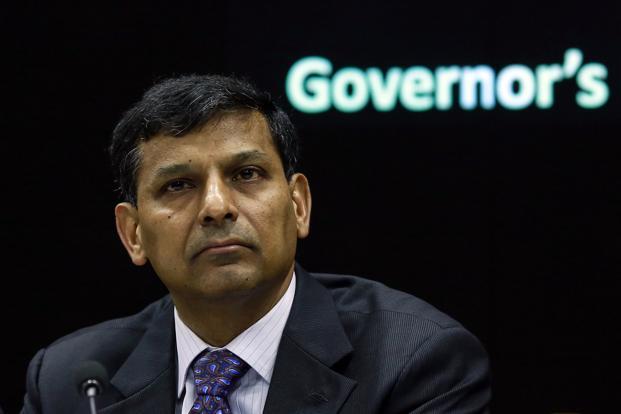
Reserve Bank of India (RBI) governor Raghuram Rajan has successfully taken away the surprise element from the central bank’s monetary policy. As widely expected, the fourth bi-monthly monetary policy, on Tuesday, did not announce any cut in the policy rate as well as banks’ cash reserve ratio (CRR) or the portion of the deposits that commercial banks need to keep with RBI. But the central bank’s concerns over high inflation seem to be more than what many would have anticipated. Rajan has also smartly moved the goal post from 8% of retail inflation in January 2015 to 6% in January 2016, in accordance with the so-called glide path drafted by the Urjit Patel committee. This means the market’s wait for a rate cut will get longer: we will probably not see a rate cut in next one year—that is till September 2015.
Indeed, the wholesale price inflation in August slowed to a five-year low of 3.74% but RBI has nothing to do with it. In fact, the nine-page policy document does not have a single reference to wholesale inflation. The retail, or consumer price, inflation, slowed marginally to 7.8% in August from 7.96% in July. This is consistent with the 8% target for January 2015. As the policy document has pointed out, the most heartening part is the 111 basis points drop in inflation, excluding food and fuel since January to its lowest level in August. One basis point is one-hundredth of a percentage point.
Food prices in the aftermath of the skewed rainfall distribution and revision of administered prices—as and when that happens—are likely to put pressure on inflation but to a large extent that can be nullified by low oil prices and a stable currency. So, RBI is reasonably confident of achieving the 8% inflation target by January 2015 but the level may not sustain for long because of the so-called base effect. According to the policy document, “the balance of risks” to achieving 6% by January 2016 “is still to the upside”. This rules out any rate cut in near future.
RBI has also refrained from a cut in banks’ mandatory bond holding or statutory liquidity ratio (SLR) but it can happen in December when it announces its next policy.
Five reasons why credit growth is at a 13-year low
Meanwhile, the policy has tried to explain why the bank credit growth has dropped to below 10% in September, the lowest level since June 2001.
• The first reason is a relatively high base effect—in last September the credit growth was 17%. Adjusting for the base effect, the credit growth this September would have been 11%.
• Another reason behind the drop in credit growth is Indian corporations’ preference for raising money through short-term commercial papers.
• Besides, they are raising money from other sources too, such as foreign direct investment and external commercial borrowing.
• Banks’ sale of bad loans to asset reconstruction companies too has led to shrinkage in their loan books.
• Finally, lower borrowing by oil marketing companies contributed to tardy loan growth.
Incidentally, public sector banks are more affected by slower credit growth than their counterparts in private sector. Rising bad loans (they do have more bad loans in their books then private banks) and the bribe-for-loans scandal have possibly made them risk averse.
The central bank has kept the growth projection for fiscal year 2015 unchanged at 5.5% but cautioned that this can be achieved only if the investment climate changes for the better. The key to this is resumption of stalled projects. Projects entailing Rs.6.26 trillion of investment were shelved, abandoned, or stalled in 2013-14, the highest ever in India’s history, according to the Centre for Monitoring Indian Economy. According to a 2013 finance ministry estimate, some 215 projects, each with value of Rs.250 crore or more, have been stalled; collectively they are worth Rs.7.02 trillion. The reasons behind the lack of progress in project completion range from lack of funds to the absence of environmental clearance.
HTM calendar: Will it work?
The policy document has also detailed a road map for bringing down the ceiling on the banks’ mandatory bond holding (SLR) under the so-called held to maturity or HTM segment. Even though the SLR floor for banks is 22%, the industry’s average bond holding is more than 28% and currently 24% of it falls under the HTM category. Bonds kept under this category are not subjected to the so-called mark-to-market or MTM losses. In other words, any variation in market prices of bonds does not affect this category. RBI wants to bring down the HTM limit to 22% in four stages over the next one year. Historically, whenever bond prices dropped and yields rose, RBI lifted the HTM limit to protect banks’ balance sheets as otherwise they would have ended up booking MTM losses that would hit their profitability. It will be interesting to see whether a calendar on HTM paring works. It’s something akin to giving a calendar on interest rates in the future.
Or, looking from a different perspective, this shows that RBI is confident about a downward trend for interest rates in India.